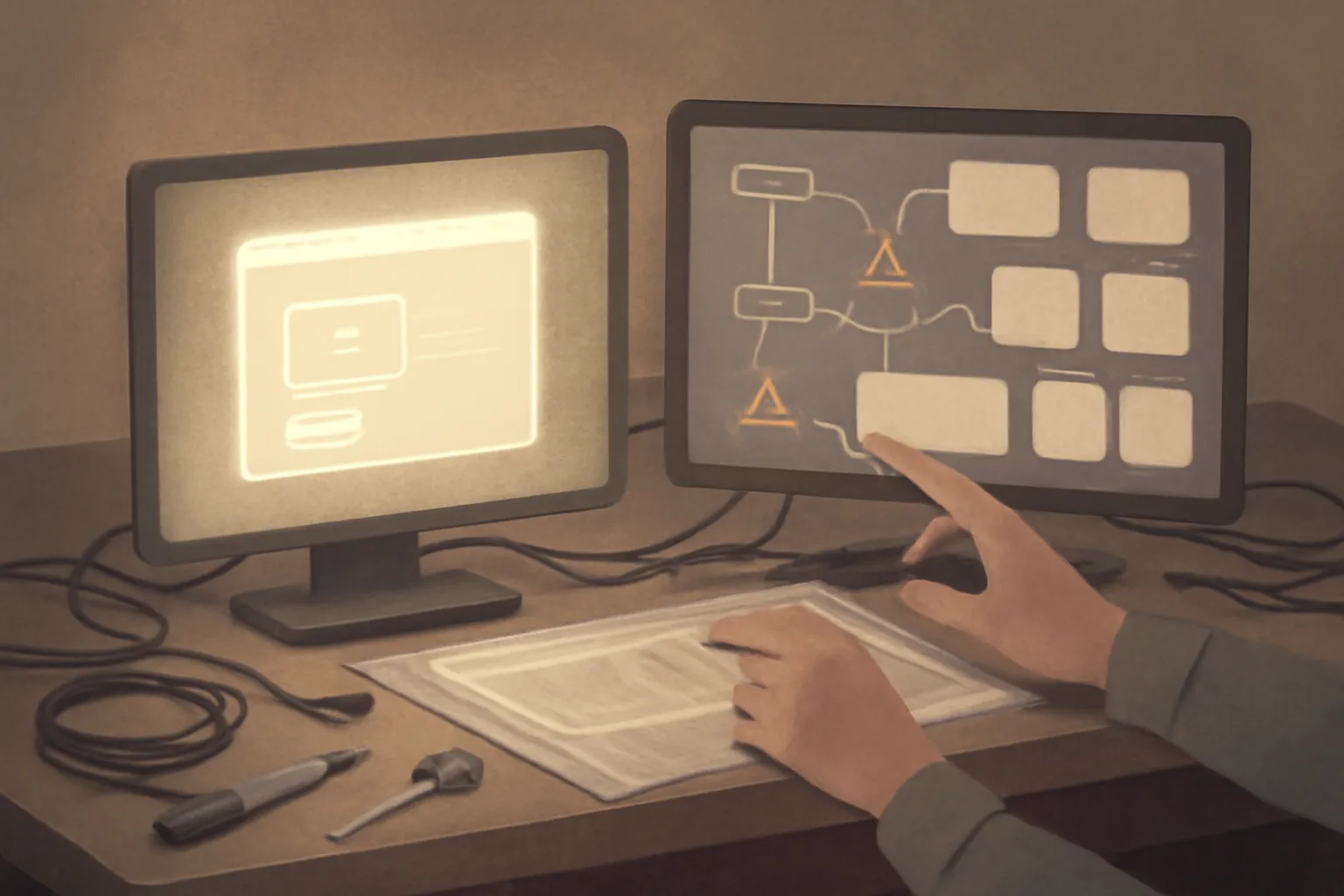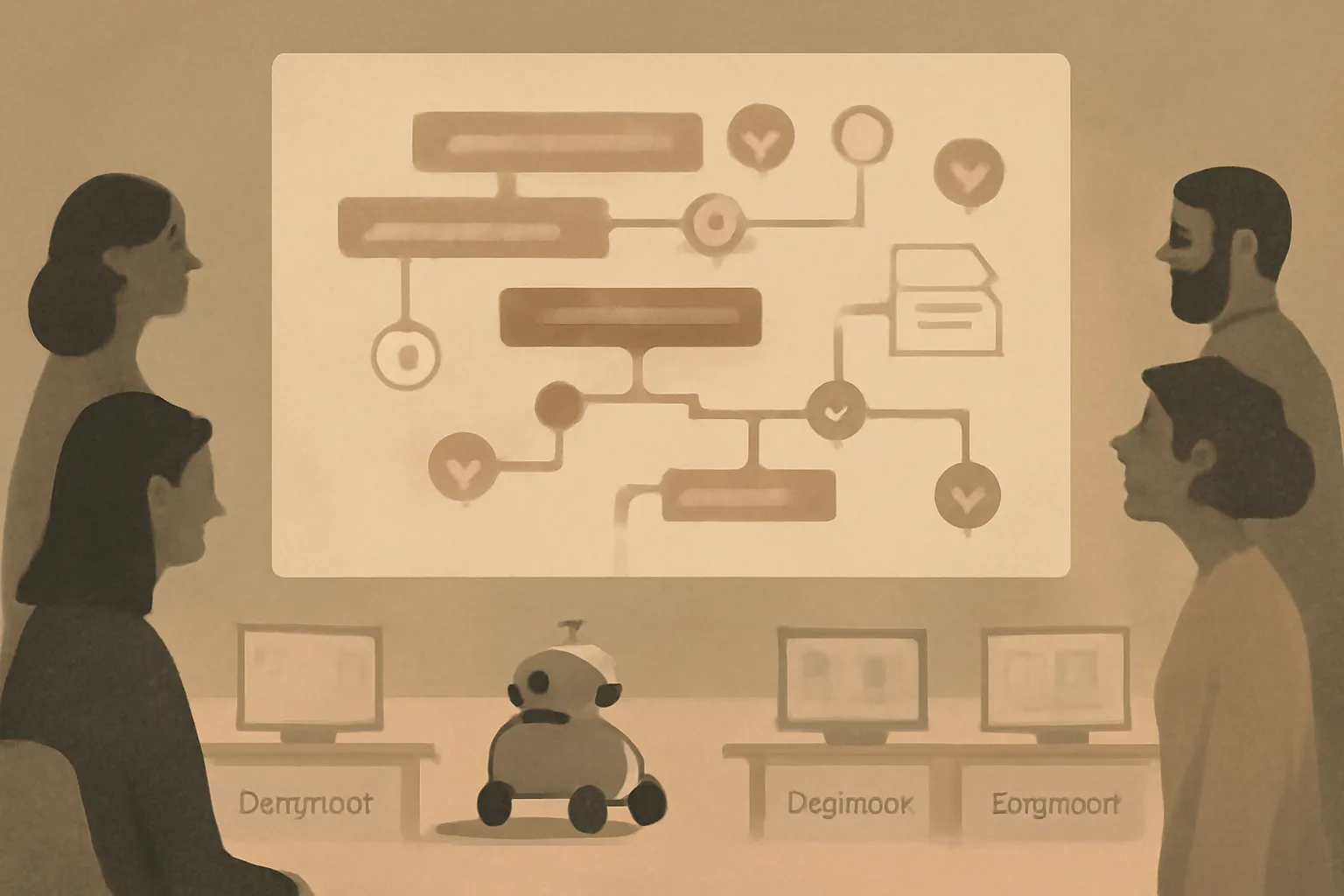
The important shift in workplace AI is not that a model can write a better paragraph. It is that a system can increasingly pursue a goal across several steps: inspect files, search connected services, create an artifact, update a record, and send a message.
That changes the professional question from “Is this answer correct?” to “What is this system allowed to do before it has to ask me?”
Zapier describes ChatGPT Work as an agentic mode that can work over extended periods with files and connected applications, while its Plan mode proposes a strategy for approval before execution. Microsoft similarly frames Copilot, organizational knowledge, and governance as complementary parts of an operational AI stack. These examples point toward a practical distinction: AI is moving from a conversation partner to a delegated operator.
Delegation can save time, but it also changes the shape of responsibility. A chatbot usually produces an output for a person to inspect. An agent may produce several intermediate actions, some of which are difficult to notice after the fact. The safest adoption strategy is therefore not maximum autonomy. It is explicit, graduated authority.
Think in actions, not prompts
A useful first step is to list the actions an AI system could take in a workflow. “Handle customer onboarding” is too broad to govern. A more useful inventory might include:
- read an internal policy and extract requirements;
- search an approved knowledge base;
- draft an email or contract summary;
- create a ticket or spreadsheet row;
- change a customer or financial record;
- invite a user, publish a document, or send an external message;
- approve a payment, delete data, or make a commitment on the organization’s behalf.
Each action has a different combination of reversibility, sensitivity, external impact, and cost. Treating them all as “AI assistance” hides the real decision.
A simple classification is more practical than a vague promise that a human will supervise everything:
- May do: low-risk, reversible actions within a clearly limited workspace.
- Must propose: actions that change shared work, communicate externally, or create a meaningful commitment.
- Must never do alone: actions involving regulated decisions, irreversible deletion, high-value transfers, access-control changes, or sensitive personnel matters.
The UAE’s government agentic-AI program provides a relevant policy example: it includes rules for deciding which tasks agents may complete and which they may only recommend. The underlying idea transfers well to an individual team: permission should be attached to the task, not granted merely because the system appears capable.
Use approval gates where consequences change
Not every step deserves a confirmation dialog. If a system asks for approval after every file read, people will approve mechanically or disable the control. Put the gate immediately before a consequential transition.
For example, an agent might be allowed to gather information, compare options, and prepare a draft without interruption. It should pause before it:
- sends anything outside the organization;
- publishes or shares a document with a new audience;
- changes a source-of-truth record;
- spends money or commits a discount;
- changes permissions or creates credentials;
- deletes, overwrites, or exports data;
- makes a decision that affects employment, eligibility, credit, safety, or legal rights.
The approval request should show the proposed action, the exact target, the material inputs, and the likely consequence. “Continue?” is a weak control. “Send this message to 2,400 customers, using the attached list, with an estimated campaign cost of $X” gives a person something meaningful to review.
For high-impact actions, require a named approver rather than whoever happens to be watching the screen. Separate the person who designed the workflow from the person who authorizes its most consequential result when the risk justifies it.
Define the agent’s operating envelope
Professionals do not need to understand every model detail to establish useful boundaries. They do need to specify the system’s operating envelope:
- Scope: which projects, folders, accounts, and data sources are available?
- Tools: may the system read, write, send, purchase, execute code, or change permissions?
- Limits: what spending, volume, frequency, or time limit applies?
- Sources: which domains, repositories, or databases count as authoritative?
- Escalation: what uncertainty, conflict, or missing information requires a person?
- Stop conditions: when must the system halt rather than improvise?
Tool access should be narrower than the user’s general account access wherever possible. An agent that can read a shared drive does not automatically need permission to email every contact. An agent that can draft code does not automatically need production credentials. A separate service account, limited workspace, or read-only connection can make an error less costly.
Write the boundary in operational language. “Use judgment” is not a control. “Do not send external email without approval; do not modify the customer database; use only the approved pricing table dated [date]; stop if two sources conflict” is testable.
Make plans inspectable before execution
Planning is one of the useful features of delegated AI, but a plan is not proof that the plan is sound. Review it as a proposed sequence of actions.
Ask four questions:
- What outcome is the system pursuing?
- Which assumptions is it making?
- Which tools will it call, and with what permissions?
- At which step can a mistake become expensive or difficult to reverse?
A good approval screen should expose the plan’s boundaries, not merely its final prose. If the system says it will “clean up the account,” the reviewer should be able to see whether that means tagging records, merging duplicates, archiving messages, or deleting data.
For recurring work, approve a policy rather than every instance only when the policy is narrow enough to test. “Automatically file invoices from these vendors under this amount, without deleting originals” is a candidate. “Manage invoices” is not.
Assume context can fail
Multi-step systems can lose track of earlier instructions, misread retrieved information, or carry forward a mistaken assumption. Research and engineering guidance in the digest highlights failure modes including context loss, prompt injection, non-termination, structured-output errors, and state rehydration problems. Berkeley’s ABBEL work also argues that compacting interaction histories into belief states can be preferable to repeatedly carrying a full history, but context management remains a performance and reliability concern.
That has a direct workplace implication: do not make a critical approval depend on the agent remembering a constraint from step two of a long run. Put important constraints near the tool call or approval gate. Require structured fields for sensitive actions, such as recipient, amount, source, justification, and expiry. If a task runs for a long time, require a checkpoint that restates the current objective, completed steps, pending actions, and unresolved uncertainties.
Be especially cautious when an agent reads untrusted material. A web page, email, document, or code comment may contain instructions aimed at manipulating the system rather than helping complete the task. Retrieved text should be treated as data unless the workflow explicitly identifies it as an authorized instruction.
Design for stopping and recovery
Delegated work needs a visible stop mechanism and a recovery plan. Set a maximum number of iterations, tool calls, or runtime for tasks that could loop. Make retries safe: creating the same ticket twice or sending the same email twice is not a harmless failure. Where supported, use idempotent operations or have the system check whether an action already occurred before repeating it.
Keep a human-readable activity record: the request, plan, tools used, data sources consulted, approvals granted, changes made, and final result. This is not only for postmortems. It lets a colleague take over when the original operator is unavailable and makes it possible to challenge a result without reconstructing an entire invisible chain.
For important workflows, test deliberately bad cases before granting autonomy. Try missing data, conflicting policies, an expired source, a malicious instruction in a document, a duplicate request, a revoked permission, and a tool that returns an error. The goal is not to prove that the agent never fails. It is to verify that failure causes a pause, a clear escalation, or a safe rollback.
A practical delegation ladder
You can introduce an agent in stages:
- Observe: the system reads approved information and explains what it would do.
- Draft: it prepares outputs, but a person executes every external action.
- Act in a sandbox: it creates test records, branches, or files in an isolated workspace.
- Act with narrow permissions: it performs reversible, low-risk actions under volume and time limits.
- Act under policy: it handles a well-tested class of tasks and pauses at defined approval gates.
Move up only when the lower stage has produced evidence that the workflow behaves acceptably. If the task changes, the tools change, or the data becomes more sensitive, move back down the ladder.
What this means for your career
The valuable skill is not simply knowing how to ask an AI for a result. It is knowing how to turn a vague delegation into a bounded operating procedure. That includes decomposing work into actions, identifying irreversible transitions, writing escalation rules, designing approval requests, and recognizing when an agent should stop.
In interviews or performance reviews, describe the boundary you designed, not just the automation you launched: “The system researches and drafts; a named reviewer approves external communication; database writes are limited to these fields; duplicate actions are checked; unresolved conflicts halt the run.” That language demonstrates operational judgment.
Agentic work will not eliminate the need for professional accountability. It makes accountability more concrete. Before you hand over a task, decide what the system may do, what it must show you first, and what it must never do alone. Then make those decisions visible in the workflow itself.
Maya Chen is the accountable human editor of AI Career Brief, covering skills, roles, and smart moves for working in the age of AI.